
You could save up to 25% on transaction costs².
Speak with us now to see if you qualify.
Talk to sales 1-800-515-8366
Monday - Friday, 6 AM to 4 PM PT

Table of contents
Table of contents
Sales, production, and employee retention all determine business success. And while it may not be the most glamorous topic, bookkeeping also plays a part. With so many other things on your plate, it may be time for you to make the executive decision of hiring a bookkeeper to take the reins.
But how much does a bookkeeper cost, and what are the exact services they provide? To learn more about the cost of bookkeeping, follow this small business guide.
A bookkeeper is responsible for recording transactions and keeping track of a business’s finances. Some common responsibilities of a bookkeeper include:
On top of this, it is also a bookkeeper’s job to keep everything organized. That way, when it is time to file your small business taxes, you can easily access all the data you need.
Additionally, a bookkeeper may work with an accountant, who is responsible for more advanced tasks such as assessing the health of a business or generating financial statements.
There are three main service tiers to consider when deciding what kind of financial support your business needs. The right choice largely depends on your business goals, complexity, and growth stage.
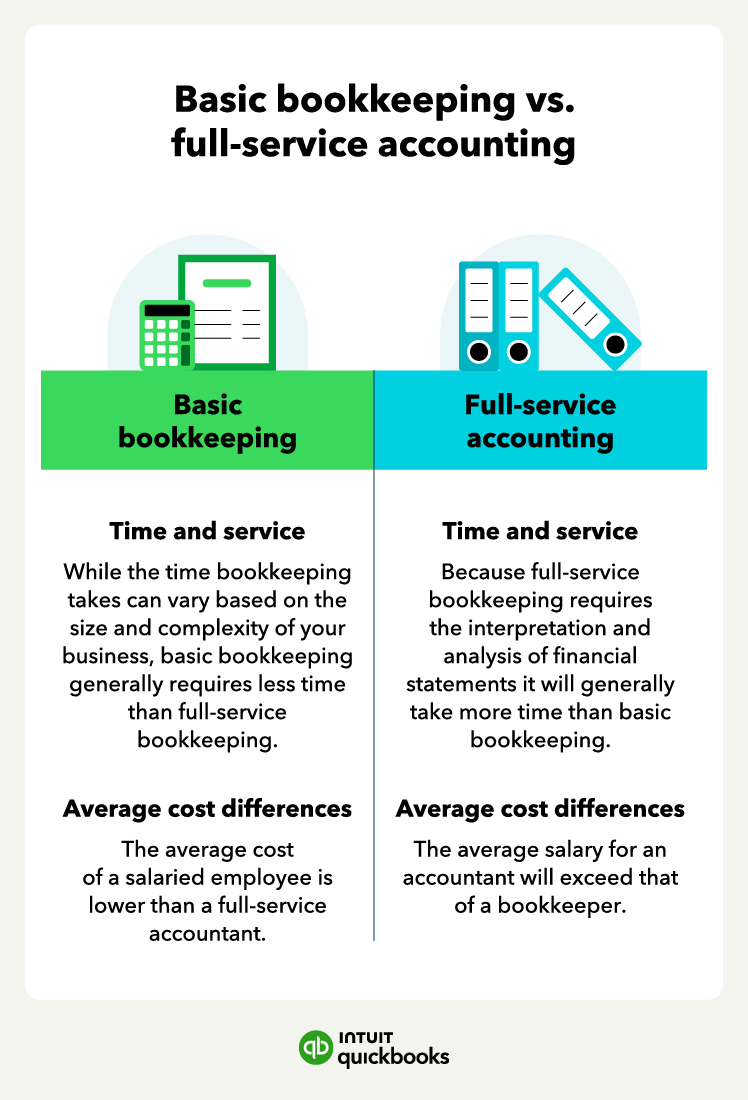
Basic bookkeeping covers the foundational recordkeeping your business needs to stay organized. This includes transaction categorization, expense tracking, payroll processing, employment taxes, and account reconciliation.
Full-service bookkeeping includes everything in basic bookkeeping, plus more comprehensive financial management like accounts receivable/payable oversight, chart of accounts setup, and financial reporting. This tier bridges day-to-day recordkeeping with organized, report-ready financials.
Whether you opt for basic bookkeeping or full-service bookkeeping and accounting, either option can help you be better prepared come tax season.
Accounting goes beyond bookkeeping to include interpreting, analyzing, and reporting on your financial data. Accountants use the records maintained by bookkeepers to evaluate your company's financial health, ensure tax compliance, and inform strategic decisions.
Accountants maintain a wide range of skill sets, including managing spending and budgets, taxes, and analysis of financial statements. To be exceptional at these tasks, accountants must complete years of training and earn special certifications, which their salaries reflect. Depending on the type of accountant, years of experience, and certifications, you could be paying a pretty penny.

For example, a Certified Public Accountant (CPA) is paid more than a traditional accountant due to having to meet higher education and licensing requirements, depending on their state.
On the other hand, bookkeepers are the more affordable option. They require the least amount of education and focus on recording transactions, whereas an accountant or CPA spends their time analyzing financial data and generating financial statements.
While these exact figures can change over time, the cost comparisons of covering your bookkeeping and accounting needs can vary greatly depending on the type of individual you hire.
As with any new hire, you’ll need a careful assessment to warrant bringing in additional hands to help run your small business. Below are some signs to help point you toward the right choice:
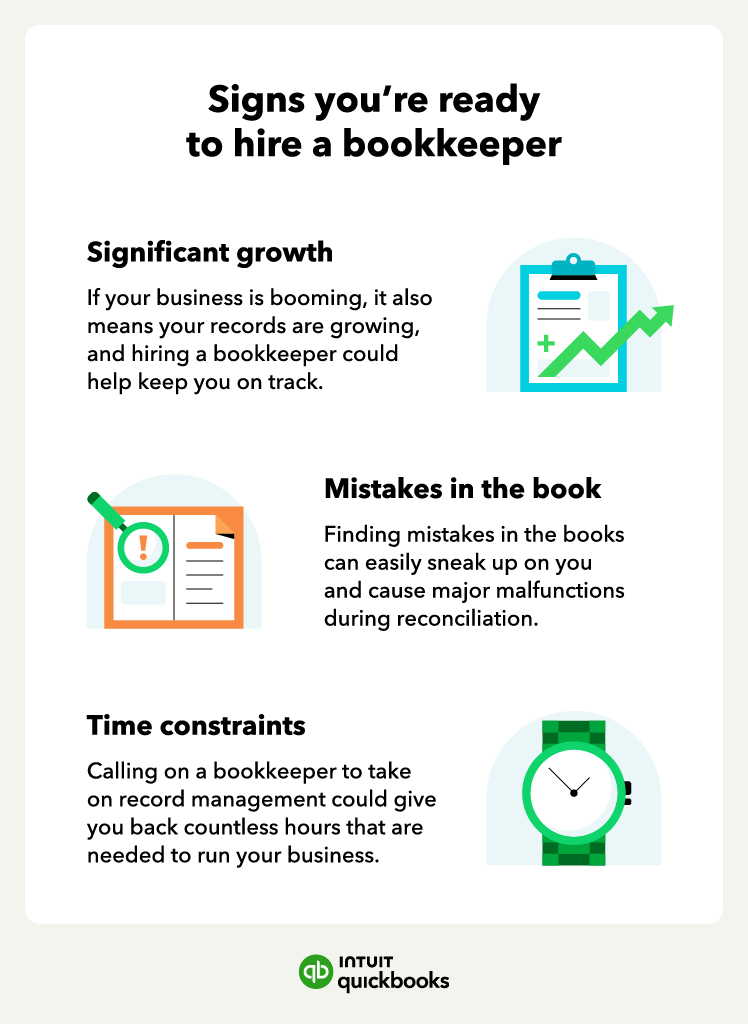
If any of these warning signs resonate with you, it may be time to hire a bookkeeper. But before you do, let’s look at some questions you should ask yourself before making the decision.
As you’ve seen, there are several solutions to this bookkeeping dilemma, but they also come with additional questions you should keep in mind before making a decision. To help you on this decision-making journey, we’ve gathered four questions to ask yourself before hiring a bookkeeper.
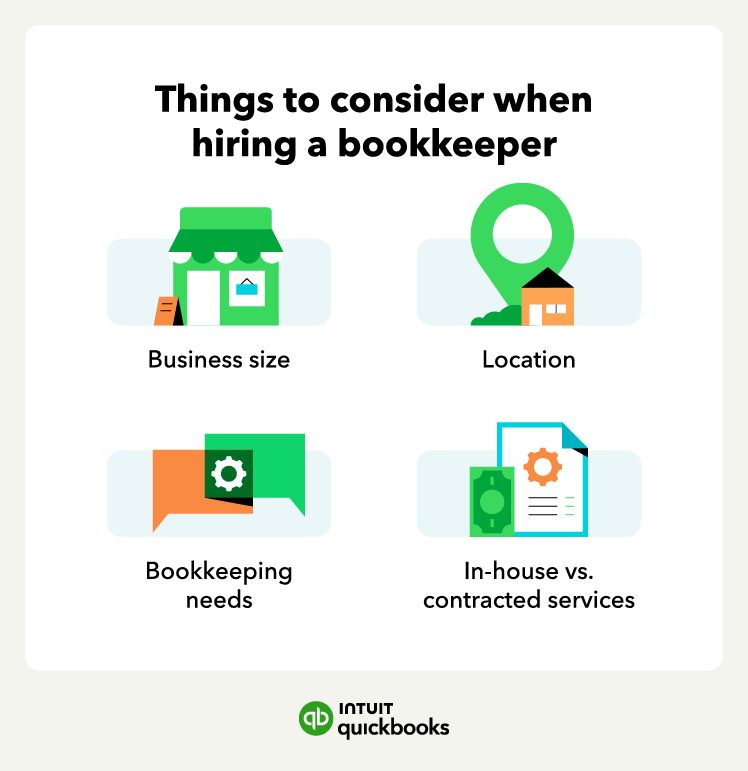
There is no magic number to know when you’re ready to take on a bookkeeper for additional support. Instead, it’s more of a holistic view of time, resources, and the ability to become more efficient that will make or break your decision. Do you need help managing your books? If the answer is yes, then size shouldn’t be your deciding factor.
However, be aware that business size does affect a bookkeeper’s workload and may lead to you paying more or even for a second bookkeeper to alleviate some of that burden.
Bookkeepers have a wide variety of skills, so one of the factors you need to consider is what you need them for. If it’s basic client billing and documentation, a good solution may be accounting software that can assist you if you still want to play a more hands-on role.
But if it’s more complex, like building out your financial outlook, you might be better off with hiring an accountant.
Depending on how much work you have and how long you need services, a contracted worker might be a better option. For example, if you’re in a sector that finds business heavier in the fourth quarter than any other time of the year (we’re talking to you, holiday bloggers), contracting may be more cost-effective than keeping someone in-house year-round.
Bringing someone on as an in-house full-time employee requires extra costs on your end, such as benefits and health care, whereas contractors are not entitled to these perks. You may not know how long you’ll need someone, but comparing the monthly bookkeeping cost of a contractor versus an in-house employee is the best way to see this angle side by side.
Where you live could cost you more. Bookkeeper salaries vary state by state (see our chart below), and depending on where you live, you could be paying a large difference in one place versus another. A better option would be to use a service like Intuit Expert virtual bookkeeping, where your bookkeeper costs would not be affected by where you live but rather how much your business expenses are per month.

If you’re wondering, “How much does a bookkeeper cost per month?” so that you can think about adding one to your team, the answer is not so straightforward.
While salary and benefits are the most obvious costs of bringing on an in-house bookkeeper, they’re not the only consideration. Physical appliances, software licenses, and office space all come into play, and the costs can add up quickly.
Instead, small businesses are moving from a full-time hire to outsourced bookkeeping services.
Where hiring a full-time, on-site bookkeeper comes with a laundry list of associated expenses, virtual business bookkeeping solutions boil down to two cost considerations.
Artificial intelligence excels at data entry and reconciliation, saving accounting teams up to 12 hours per month. These tasks were once principal responsibilities of human bookkeepers, but in 2026, SMB owners can use AI to automate everything from payroll to expense tracking.

It may seem that there aren’t a lot of tasks left over for bookkeepers. And you may wonder where your money is actually going.
The reality is, bookkeeping has switched from data entry to providing necessary oversight as a data validator and systems manager. The price you pay for service may contribute marginally to AI upkeep, but nearly 100% is reflective of the value of having a human in the loop.
While human bookkeepers are no longer glued to their calculators, their oversight of AI processes and advisory expertise is invaluable to small businesses.
As great as it is to talk about potential bookkeeping costs and get estimates, we know that seeing an actual average for your state can yield excellent value for you as a business owner.
Please see the chart below, which pulls data directly from the US Bureau of Labor Statistics 2024 data, to answer the question: “How much does a bookkeeper cost per hour and per year?”
While doing your own bookkeeping may seem like a good idea initially, you could face these indirect costs:
Outsourcing accounting services allows you to reap the benefits of an accountant without the costs of a full-time employee, such as insurance and other benefits.
In-house accounting, on the other hand, gives you peace of mind knowing that someone you know and trust is handling your books and finances. The only drawback of paying a full-time accountant is that you may need to offer them employee benefits.
Based on the average salary of a bookkeeper, you should be paying roughly $3,516 a month for bookkeeping if you choose to hire a bookkeeper. Keep in mind that this bookkeeping cost per month depends on your bookkeeping needs, where you run your business, and if you decide to hire an in-house bookkeeper or use online bookkeeping services.
Deciding whether to do your bookkeeping yourself or hire outside help is entirely up to you. DIY bookkeeping is cheap but is limited to your own expertise and can be a significant time commitment. On the other hand, hiring an in-house bookkeeper frees up time, but their expertise comes at a high price.
You can get the best of both worlds with the right AI-powered accounting software. Advanced accounting platforms like QuickBooks lets you handle bookkeeping yourself without the major time cost.
With DIY, SaaS, and in-house options available, switch from asking yourself, “How much does a bookkeeper cost?” to “What kind of bookkeeper is right for me?”
Only you know the best route for your business. But if you’re like countless other small business owners, you may find that using online accounting software saves you time and money, all while meeting your bookkeeping needs.









Call Sales: 1-800-285-4854